01
Write one sentence
'Open a project named 123 Website, priority high, due Dec 19. Add Header Design task, assign to Alice, Dec 12.' — reach the slash command panel from any screen.
Write one command: project opens, task added, assigned, dropped on the calendar. No forms — Mana reads your sentence, extracts what's needed, asks for your approval. Work production at the speed of thought.
Screenshot slot ready
When the visuals arrive they'll drop into these frames — sized and shaped for product screens.
No sign up, no card, no setup. One click opens the real dashboard with projects, tasks, Mana AI and the calendar — exactly as if it were your own account.
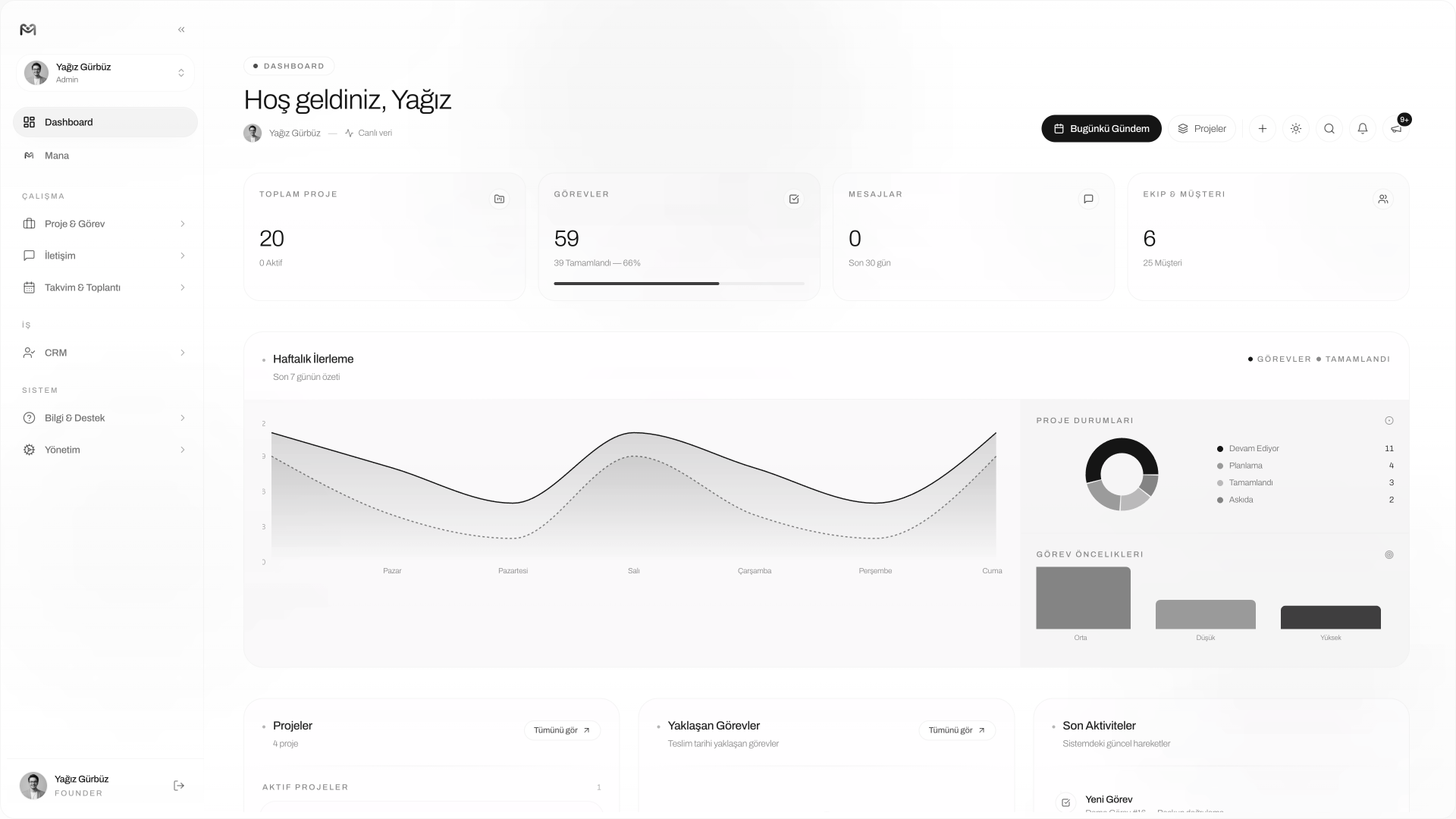
Ready? Step inside the system.
No sign-up · No card · Open in 1 second
You leave a meeting with 12 actions; clicking through each one eats half your day. The task system is feeding off you — it should be the other way around.
Seven fields per new task: name, description, priority, date, tag, assignee, project. 12 actions discussed in a meeting — half an hour eaten by forms.
Actions were spoken, no one took notes. Next day starts with 'who was doing what?' — 3 tasks forgotten, 2 assigned to the wrong person.
'Can you handle this?' messages flood in. The task never lands in the system; who, what, when — only in chat history. Whoever remembers, does it.
Opening 10 tasks one by one takes 20 minutes. The team waits while you click; you stopped doing work and started feeding the system.
'Urgent' means something different to everyone. A task opened without a date gets forgotten; without priority the whole list looks equal.
Same 8 tasks every week. No time to build a template; you re-enter from scratch every time, an hour evaporates.
You type, Mana reads; extracts and shows; you approve, the system builds. Inside Work Relationship Management (WRM) a command is not just input — it's an action wired to every module.
'Open a project named 123 Website, priority high, due Dec 19. Add Header Design task, assign to Alice, Dec 12.' — reach the slash command panel from any screen.
Project name, priority, date, assignee, sub-tasks — Mana reads them from your sentence. If something is missing it asks; if it has the info, it never asks twice.
Mana says 'I'll create this': project + tasks + assignments + dates listed clearly. You approve, the system builds it in one shot.
Approve; project opens, task is assigned, lands on the calendar, the right person gets a notification. No 'I was going to' — it's done.
Not just one command panel — a task production system that runs on every screen, in every context, every language and every device.
You don't fill 7 fields to open a task. You write one sentence; Mana extracts project, date, priority, assignee and offers it for approval. Thought speed instead of click speed.
Which project you're in, which client you're working with, who's on your team — Mana knows. When you say 'give this to Alice', it doesn't ask who Alice is.
'Add 5 tasks to this project: design, code, test, content, launch' — Mana creates them all in a single command. No separate screen for bulk entry.
Mana never makes permanent changes without asking. It shows a preview, you approve, the system builds. Undoing a wrong command is also a single click.
A command isn't just a sentence; Mana reads it, knows your project, team and calendar, performs the extraction, asks if anything is missing and asks for approval on critical actions. Generic chatbots reply; Mana runs your system.
EXAMPLE COMMAND
"Open project 123 Website, priority high, due Dec 19. Assign Header Design task to Alice, Dec 12."
Freelancer
Email from the client: '5-page corporate site, logo included, delivery in 3 weeks'. One sentence to Mana: 'Open a 5-page web project for client X, delivery 3 weeks, sub-tasks: brief, wireframe, design, code, launch.' Project opened, 5 sub-tasks dropped on the calendar with dates, linked to the client card. 30 seconds, 0 forms.
Agency account manager
45-minute client meeting, 12 actions discussed. By the time it ends Mana has read the transcript, listed the 12 tasks by 'who does what', and proposed delivery dates. You approve in 30 seconds — tasks are assigned to the team, the 'note-keeping' job disappears.
Software team lead
Tuesday morning sprint planning. '2-week sprint, open 8 tasks: API auth (Mert, 3 days), dashboard (Alice, 5 days), payments (Burak, 4 days)…' — Mana sets up the sprint, checks capacity, and asks 'Alice is at 95% — should we hand it to Mert?' for conflicts. Plan ready in 2 minutes.
The table below compares the task creation approach of popular tools and the natural-language + context + approved-action edge of Managelify.
The production layer that runs the command; context, suggestion and action in one place.
Tasks generated by commands; managed with priority, status, assignment, sub-tasks.
Projects opened with a single command; bound to team, calendar and file context.
Auto checklist generation with 'add these steps' commands.
Meeting transcript → automatic action suggestions, no command needed.
Dates from commands land directly on the calendar; Mana spots conflicts.
You open the slash (/) command panel or press ⌘K and type in natural language: 'Open project 123 Website, priority high, due Dec 19, add Header Design task, assign to Alice.' Mana parses the sentence; extracts project name, date, priority, assignee, sub-tasks; shows you a preview; once you approve, project + tasks + assignments + calendar entries are created in one shot. No forms, no clicks — just a sentence.
Both, in a single command. Say 'Open a new project for client X, 5 sub-tasks: brief, wireframe, design, code, launch' and Mana sets up the project, adds the sub-tasks in order, links it to the client card, and proposes team assignments. Multiple tasks, one shot — without opening extra screens.
Yes, both are first-class. Relative dates ('next Friday', 'by Monday', 'in two weeks') are resolved correctly; phrases like 'urgent', 'important', 'low priority' map to the priority field. Turkish is optimized natively (not translated) with full character support (ı/ğ/ü/ş/ç/ö); bilingual teams use both side by side without friction.
Yes. On mobile and desktop you can press the mic icon and speak: 'Schedule a meeting with Ahmet for tomorrow 10am, then open a 30-minute follow-up task for me.' Mana chains voice → text → command; especially useful while driving or jumping between screens, where speaking beats typing.
Yes. When a Managelify Meet, Zoom, Google Meet or Microsoft Teams recording is transcribed, Mana reads the transcript, extracts action items, and suggests 'who does what' assignments and due dates. After the meeting you review the suggestions and approve in 30 seconds — the 'note-keeping' job disappears entirely.
Mana never makes permanent changes without your approval. When you submit a command a 'I'll create this' preview appears; you can edit, cancel or rewrite. Even after approval, every action is recorded in the audit log; one-click undo is supported and unauthorized actions never happen in the first place.
Yes. Save frequently used commands as shortcut templates: when you type 'Weekly client report', Mana pulls 8 sub-tasks, assignments and dates from the previous template. It also learns from past commands; when you start typing a similar one, autocomplete suggests it so you never repeat yourself.
A task created with a single command is automatically: linked to Project Management, dropped on the Calendar, attached to the relevant Client card (if any), assigned to the right person via Team & Role Management, and delivered through Notifications & Inbox. One flow (WRM) — command, task, calendar, client, team all live in the same context.
MANAGELIFY
Write your first command, open your first project in seconds. No forms, no clicks — just thought, sentence, action.