01
Pick the trigger
'When a project is created', 'when a task is completed', 'when a customer goes silent for 14 days', 'every Monday 09:00', '30 days before contract end' — system events or time become triggers.
Trigger → condition → action. Managelify runs reminders, assignments, status updates, onboarding/off-boarding; Mana AI suggests, you approve. Not a context-free Zapier — inside the system.
Screenshot slot ready
Visuals will land in these frames — sizes and ratios are tailored for the product UI.
No sign up, no card, no setup. One click opens the real dashboard with projects, tasks, Mana AI and the calendar — exactly as if it were your own account.
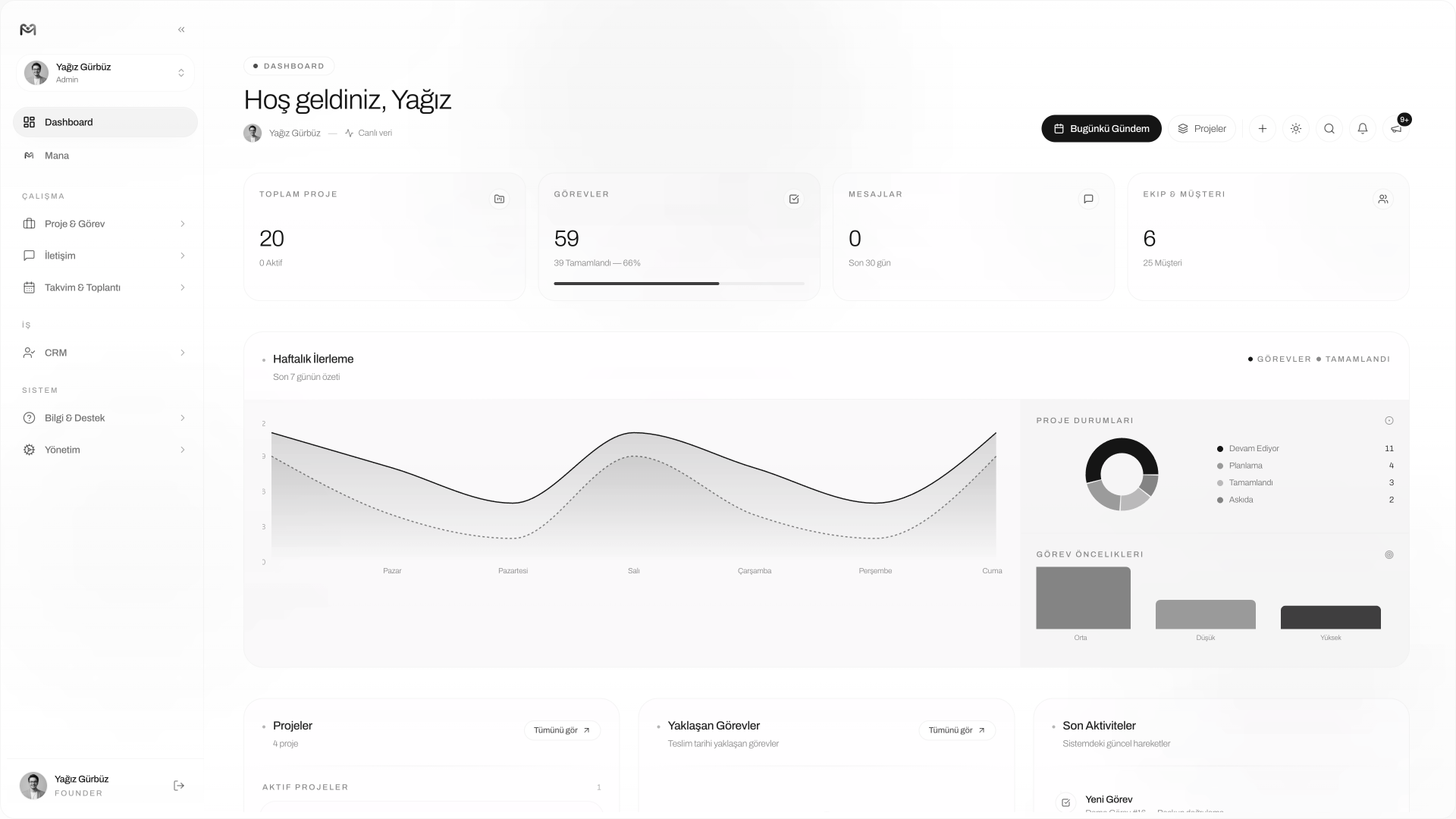
Ready? Step inside the system.
No sign-up · No card · Open in 1 second
Pinging the same task once a week isn't work; it's a missing system. Automation tools just shift the chaos elsewhere — webhook mysteries that don't know your system.
Every Friday you ping the same report, every month you chase the same invoice. You're not doing the work — you're reminding others to.
You wired triggers across 5 tools; when one breaks no one knows what blew up. Context-free rule engine, every flow is a 'webhook mystery'.
Task is done but status still says 'in progress'; the report goes out wrong, the client asks 'where are you?' — nobody noticed.
New teammate joined — which 12 things must you set up? Someone left — which 8 accesses must you revoke? Every time it's an Excel sheet.
Contract expired and nobody knew; the customer quietly churned, recovery cost is 5x. The reminder 'was written down somewhere'.
Every sprint the same 14 tasks. No time to build templates; you spin them up from scratch and lose 1–2 hours a day.
Automation is an engine that sees Managelify's projects, customers and calendar. Inside Work Relationship Management (WRM), actions aren't a side system — they live in the same context; Mana AI strengthens them with suggestions.
'When a project is created', 'when a task is completed', 'when a customer goes silent for 14 days', 'every Monday 09:00', '30 days before contract end' — system events or time become triggers.
'If priority is high', 'if customer is on the Pro plan', 'if the task is overdue' — conditions chain with AND/OR; no noise, only the right context fires the action.
Create a task, assign it, update status, send a customer notification, add a calendar event, post a team message, prepare a file — single action or a multi-step chain.
Critical actions (external messages, payments, contracts) are first surfaced to you by Mana AI. Approve, run — or edit. The audit log records every action.
Not a context-free webhook — a rule engine that touches your full system context, strengthened by Mana AI suggestions and fully auditable.
Automation is an engine that sees Managelify's projects, customers and calendar. No webhook mysteries; trigger, condition and action run in the same context.
Mana sees what repetition can be automated: 'you ping the same report every Friday — should I make a rule?' — you approve, the rule runs.
Critical actions (external messages, payments, contracts) ask for your approval. The audit log records every trigger, condition and action; rollback is supported.
Type 'open a follow-up task for the account owner 30 days before contract end'; Mana drafts the trigger + condition + action setup. No complex visual editor — just a sentence.
Mana spots frequent repetition and proposes automation; drafts trigger+condition+action setups from a natural-language prompt; adds risk score and capacity data as conditions. On critical actions it always asks for your approval — control stays with you.
EXAMPLE RULE
"Open a follow-up task for the account owner 30 days before contract end and set up a weekly reminder."
Freelancer
When a new customer signs up: a 'welcome' email goes out, the brief form is shared, an onboarding call lands on the calendar, a payment reminder fires after 7 days, and 30 days before renewal you get a follow-up task. 5 actions, 0 manual work.
Agency
New teammate joins → 12 tasks open automatically (accounts, training, mentor, first project). They leave → 8 access-revocation tasks fire from one trigger (email, drive, code, channels). No more Excel sheets; the process is now a system.
Software & B2B team
When a sprint opens: 14 standard task templates load, the planning meeting drops on the calendar, retro is reserved. On close: the completion report is auto-generated, the retro agenda is prepared, the next sprint opens. The process is systemized; the team stays focused.
The table below shows the strengths of popular automation tools and how Managelify differentiates with context + Mana AI + approved actions.
The production layer for automation suggestions, rule setup and decision support.
Build actions and automation rules in natural language.
Actions tie to tasks; priority, status and assignment update automatically.
Customer silence, renewals, tone — wired into automation as triggers.
Actions land on the calendar; date-based triggers run in sync with it.
Off-boarding triggers a one-shot access-revocation checklist.
Automation & Actions is a rule engine inside Managelify that chains trigger (event/time) → condition → action. Zapier connects 'from outside' to your system; it doesn't know your projects, customers or calendar — it's a context-free webhook engine. Managelify's automation lives inside the system: it runs in the same task, customer, team and calendar context, with Mana AI providing suggestions and decision support.
Event triggers (new project, task completed, customer added, file uploaded), time triggers (every Monday 09:00, the 1st of the month), date-based triggers (30 days before contract end), communication triggers (channel message, DM), form responses, post-meeting events, customer silence, and external system webhooks — all are supported.
Create and assign tasks, spawn projects/subtasks, update status and priority, add notes to a customer record, add calendar events, send channel or DM messages, send emails/notifications, prepare contracts/forms/files. You can run a single action or a multi-step chain; every step can branch on a condition.
No. You can build it in natural language: type 'open a follow-up task for the account owner 30 days before contract end' and Mana AI drafts the trigger + condition + action setup; you approve, the rule activates. No complex node-based editor — just command, preview, approve.
Yes. Critical actions like external customer messages, payments and contracts run in 'request approval' mode — they're surfaced to you, you approve or edit. You can also run an action in test mode and see its effect without firing for real (log only). The audit log records every trigger, condition and action step.
Mana AI works on three layers: (1) suggestion — 'you ping the same report every Friday, should I make a rule?'; (2) build — drafts the trigger + condition + action setup from a natural-language prompt; (3) decision support — wires risk scores, customer tone and capacity data in as conditions. Not intuition, data.
Yes. You can run a rule in test mode and see its effect first (no real action). If a live action ran wrong, the audit log lets you trace it step by step; one-click rollback is supported for most actions. The frequency limit (anti-spam) prevents chained actions from spiraling out of control.
Automation is wired straight into the Work Relationship Management (WRM) core: Task Management, Project Management, CRM, Calendar, Team & Roles, Access Control, Recording & Transcript, Forms & Contracts — all are usable as triggers and actions. It's built in natural language with Command-Driven Task Creation, and reasoned about with Mana AI. One flow: project + task + communication + CRM + calendar — automation touches all of them.
MANAGELIFY
Set up your first automation, kill the first repetition. Mana suggests, you approve — control stays with you, and your throughput compounds.