01
Set up the team, invite members
Engineering, Design, Marketing, Customer Success — set up as many teams as you have. Invite members by email; one-click onboarding, no scattered registration across 6 tools.
Group teams, define roles, narrow permissions by project & customer. Off-boarding in 1 click, audit trail transparent; Mana AI balances capacity and suggests the right person.
Screenshot area ready
When the visuals arrive they'll slot into these frames — sized and proportioned for the product UI.
No sign up, no card, no setup. One click opens the real dashboard with projects, tasks, Mana AI and the calendar — exactly as if it were your own account.
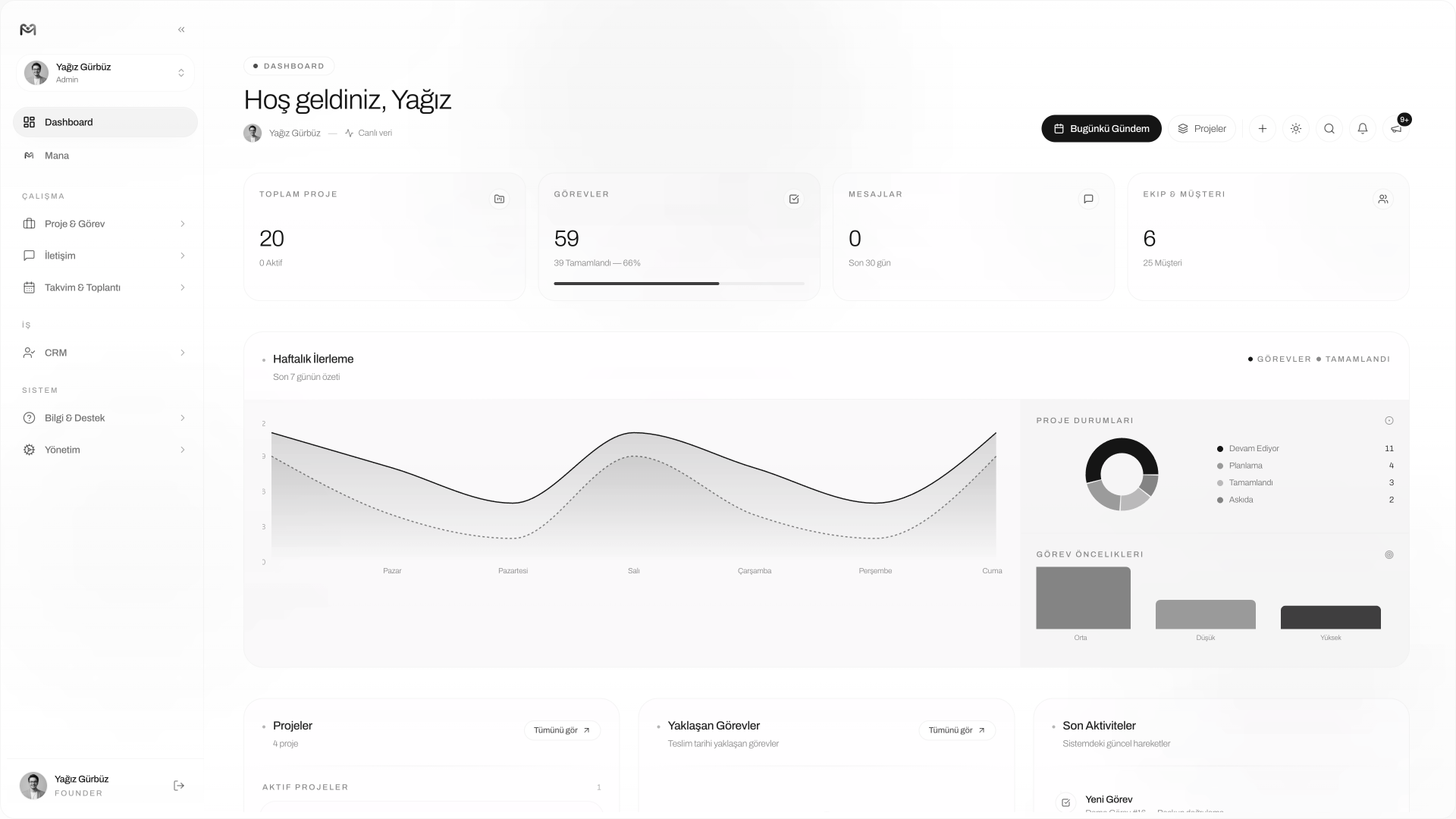
Ready? Step inside the system.
No sign-up · No card · Open in 1 second
18 people in Slack, 12 in Drive, 9 in Trello; someone resigns, account closure is 'forgotten'. Customers see internal notes, in audits 'who saw what?' has no answer.
The team is supposedly in a group; but who saw what, who approved what is unclear. When a member leaves the archive is lost; new joiners can't be onboarded.
The permission list is in Excel; in the actual tools nobody knows who has access to what. One breach, one resignation — every card is on the table.
18 people in Slack, 12 in Drive, 9 in Trello. Onboarding takes a week; on resignation account closure is 'forgotten' — a serious security gap.
One person holds all permissions. When they're on vacation work stops; or the wrong person deletes everything. Not a scalable structure.
Internal notes, pricing, draft deliveries leak to the customer. One slip — reputation lost, contract dispute begins.
A 'you can look at this' culture. No written rules; role changes are off the record; in audits 'who saw what and why?' has no answer.
In classic tools permissions are scattered and verbal. Managelify ties permissions to projects, customers and modules. We call it Work Relationship Management (WRM) — you don't just manage permissions, you manage the structure of the relationship.
Engineering, Design, Marketing, Customer Success — set up as many teams as you have. Invite members by email; one-click onboarding, no scattered registration across 6 tools.
Owner, Admin, Member, Customer, Guest — use the ready-made roles or create your own. Grant module-based permissions: who views, who edits, who deletes.
Permissions aren't only org-wide; they're project- and customer-scoped. The agency account manager only sees their own customers; the designer only the projects they're assigned to.
Mana AI spots who is overloaded and who is idle. 'Engineering is at 92% capacity, want to shift the new task to Design?' — capacity decisions become data-driven.
Slack grants permissions and stops there. Managelify pairs permission with context, audits it, balances it — the loop closes.
As teams grow, 'who sees what?' becomes bigger than the work itself. Managelify manages permissions from a single panel — structure instead of chaos.
When a member leaves, every access closes with one click; sessions drop, shared files become transparently visible. The 'forgotten account' from resignations is gone.
Internal notes, pricing talks, draft deliveries stay with the team; only approved deliverables and shared files reach the customer. Transparency + privacy at the same time.
Mana AI knows which team is overloaded and which member is idle. It suggests the 'right person' for new tasks; in off-boarding it reminds you of permission cleanup.
Mana AI analyses who's overloaded and who's idle; it suggests the 'right person' for new tasks. It flags roles defined more broadly than needed and reminds you of forgotten permissions during off-boarding — capacity decisions become data-driven, not gut-driven.
SAMPLE SUMMARY
"Engineering is at 92% capacity, Design at 48%. Want me to shift the new 'landing' task to Design?"
Freelancer
On a delivery you bring in a subcontractor designer. With the Guest role you grant access only to that project, only for 14 days. When the work ends the permission expires automatically; customer data is safe and you don't lose work.
Agency
The account manager only sees their own portfolio; the designer accesses files for the projects they're assigned to; production only looks at the approved brief. Internal processes don't leak to the customer; new members are integrated within a day.
Startup & B2B team
A KPI dashboard for investors, an operational view for the team, the full system for founders. Off-boarding closes accounts in a click; the audit trail is GDPR-compliant. Permission chaos doesn't appear as you scale; the structure is built from day one.
The table below shows the strengths of popular permission tools and Managelify's contextual team & role management in a single panel.
Permissions narrow at the project level; you decide who sees which project.
Customer record permissions; account managers only see their own portfolio.
Role-based view, download and share permissions for files.
Channels are team-scoped; communication stays between the right people.
Page & widget permissions; internal notes don't leak to customers.
See Managelify's 8 categories and 33 modules in one panel.
Managelify Team & Role Management lets you build teams, invite members, define roles, and manage module-based permissions from a single panel. Who sees which project, who downloads which file, who touches which customer — you set it transparently and auditably. Permission management that was scattered across Slack + Drive + Trello is unified into one flow.
Owner, Admin, Member, Customer and Guest roles come built in. Alongside them you can define unlimited custom roles: 'Account Manager', 'Designer', 'Production', 'Investor View', and so on. For each role you set module-based (project, task, CRM, file, finance) and action-based (view / edit / delete / share) permissions.
Yes. Permissions can be narrowed organisation-wide, by team, by project or by customer. An account manager can only see customers in their portfolio; a designer can only access files for the projects they're assigned to. Information doesn't spread unnecessarily and the audit trail stays clean.
No. The Customer role is purpose-built: they only see the tasks, files and messages you approve. Internal notes, pricing talks and draft deliveries stay with the team. You give the customer a real 'portal' experience — transparency and privacy at the same time.
You off-board them in one click: every access closes, active sessions drop, shared files stay transparently visible to the organisation. Mana AI also gives you a permission cleanup list: 'Who do you want to hand this member's tasks over to?' No account is forgotten, no data is left exposed.
Yes. You can enforce 2FA across the organisation. Every access and permission change is kept in the audit trail: who, when, what they accessed, which permission they changed — logged in a GDPR-compliant way. The audit trail report can be exported as CSV or PDF.
Mana AI analyses team capacity, spots overloaded members and suggests delegation. It flags permission anomalies like 'this role is defined more broadly than needed'; in off-boarding it reminds you of forgotten permissions. For new tasks it suggests the 'right person' based on past performance — capacity decisions become data-driven, not gut-driven.
Yes. From solo freelancer to 100+ person agency, it scales on a single architecture. It supports unlimited teams, unlimited custom roles and sub-team structures within teams. Onboarding takes one minute with role templates; off-boarding finishes in one click. Permission chaos doesn't block growth — Managelify builds the structure, you do the growing.
MANAGELIFY
Set up your first team, invite your first member, define your role with one click. Off-boarding in 1 click, audit trail transparent — the structure won't crack as you grow.